From Influenced Choices to Outsourced Thinking

Two complementary arguments. One from Jovan Kurbalija, about how social media algorithms already shape what individuals see and how we decide. And how AI pushes digital agency further, from influenced choices to outsourced thinking. The challenge is to reclaim control over knowledge itself: how it is produced, filtered, and governed.

Second, Howard You shows a similar erosion within organisations. Their agency weakens because they optimise for stability over awareness, losing their ability to adapt and respond, until they eventually “lose their minds.”
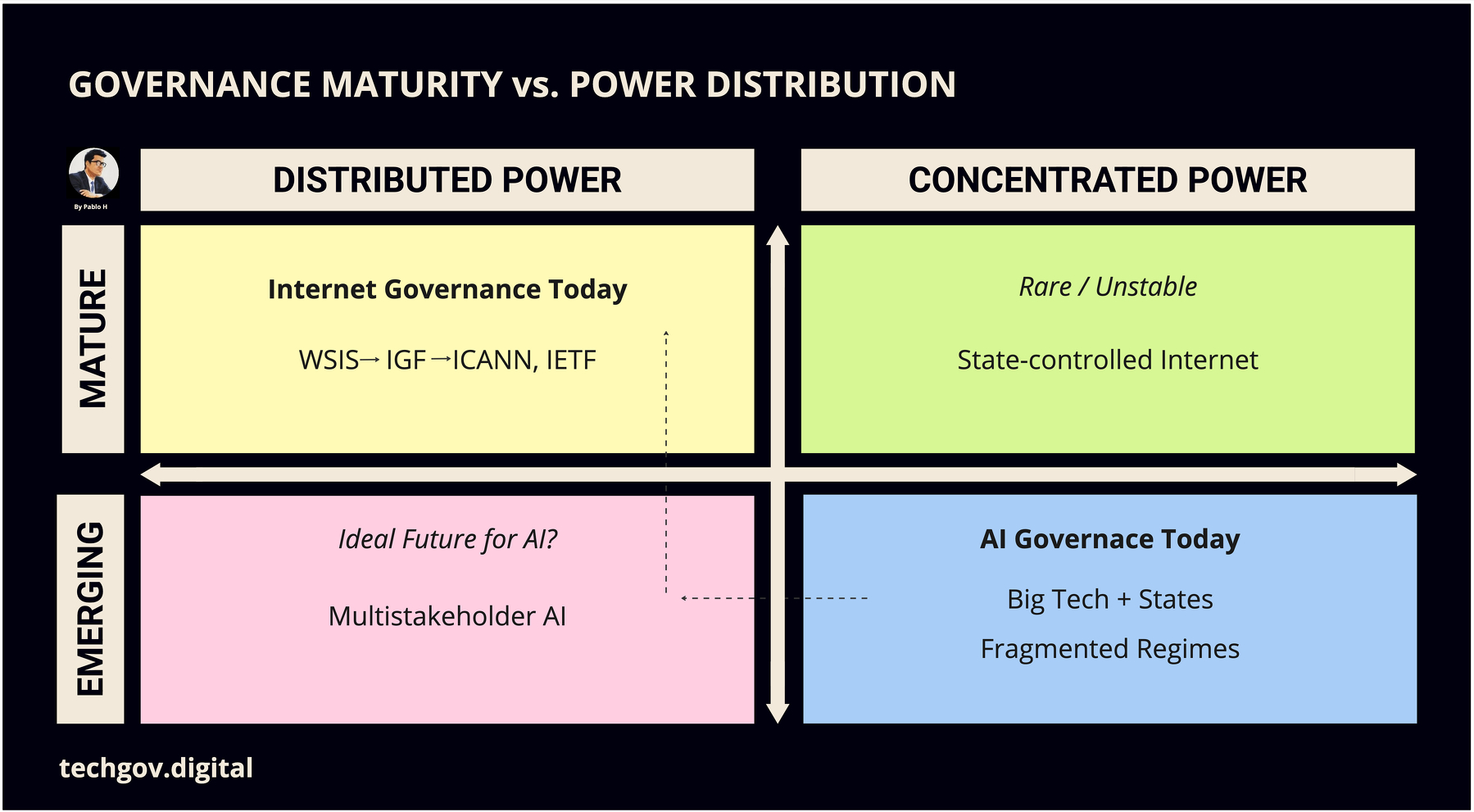
AI Governance Maturity vs Power Distribution

A side-by-side comparison of Internet governance and AI governance, highlighting their stages of evolution and underlying power dynamics. It draws on the history of Internet governance to surface patterns, tensions, and lessons that are increasingly relevant as AI systems scale globally.

Internet governance and AI governance comparison

Who in the C-suite should own AI?

“We need a different approach. That approach should begin by shifting the question from ‘who owns AI?’ to ‘who owns which AI-related decisions?’ The first question frames the issue as zero sum and invites a land grab, but the second decomposes the problem into specific decisions and assigns each to the person best positioned to make it.”

“To make the shift from ownership to decision rights, companies will need to put into place a decision and accountability map. This entails identifying critical choices and assigning each to a specific executive.”

Toby E. Stuart, March 2026, HBR

Internet Resilience Forum 2025

Internet Resilience 2025

Facilitated the Internet Resilience Forum at UCLA in Los Angeles. One of the key lessons: artificial intelligence is fast becoming a new layer of systemic risk. As the Internet shifts toward agents that communicate, negotiate, and act on behalf of users and organisations, failures will happen more frequently. We tend to anthropomorphise these systems, often trusting them beyond what is warranted, amplifying the risk of misuse or misunderstanding.

Specific vulnerabilities are emerging: hidden prompts that subtly subvert agent behaviour; agent-to-agent “drift” that distorts original intent; and the growing difficulty of tracing errors across automated chains.

Managing this next layer will require shared architectural standards, including Agent-to-Agent (A2A) protocols and the Model Context Protocol (MCP), to ensure predictable behaviour and enable verifiable interactions.

📸 With Vint Cerf. Click the image to open the gallery which shows UCLA’s Boelter Hall 3420, where the first ARPANET message was sent, featuring moments with Leonard Kleinrock, Nick McKeown, and David Cross.

Internet Resilience Experts Workshop​

2025 Internet Resilience Experts Workshop

The Internet Resilience Experts Workshop at ICANN Headquarters in Los Angeles, brought together practicioners for a trusted conversation. We focused on two tracks:

  • A Business Resilience Guide, turning hyperscaler continuity practices into practical steps for SMEs.
  • Internet Resilience Mapping Exercise, tracing the “life of a packet” to visualise the Internet’s dependency chain across power, infrastructure, cloud, and governance.

Resilience only becomes real when you can operationalise it.

📸 With John Janowiak, President & CEO of the Marconi Society